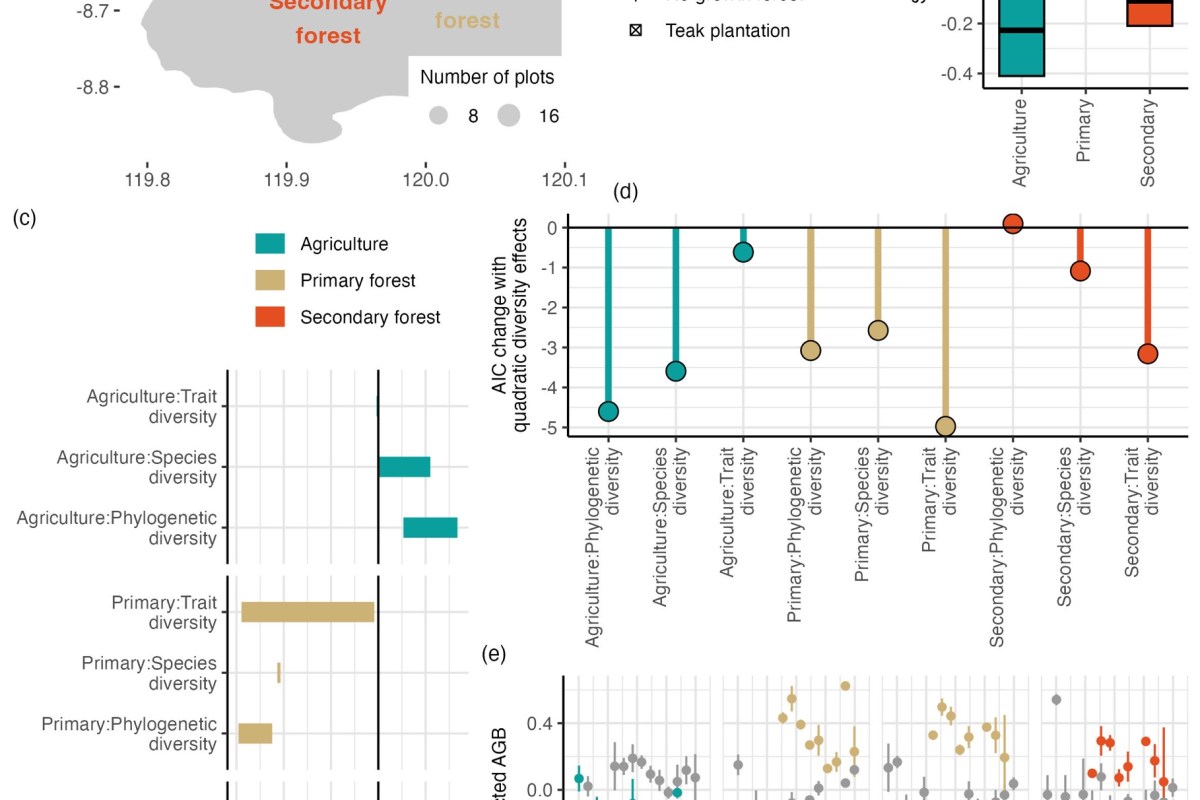
Considerable field effort led by Wahyu Adinugroho and colleagues across a landscape from intact seasonally dry tropical forest to converted agricultural land and teak plantations has shown how different aspects of plant diversity shape their carbon stocks. The piece was published earlier in the year in the Journal of Tropical Ecology as part of a special collection on the equatorial forests of the Asia-Pacific.
Using evolutionary data and a new dataset of traits from species taxonomic description we were able to measure not only species richness but also phylogenetic and trait diversity. As you might expect carbon was greatest in primary forests and lowest in agricultural landscapes. We also found that an initial build-up of diversity increases carbon, but greater diversity, beyond an optimum level, causes carbon decline.
This tells us that in these seasonally dry landscapes protection of biodiversity and carbon stocks may have to be traded off against each other to achieve workable solutions for climate change mitigation and global biodiversity targets.

